The Button Dilemma: A Game of Trust
are you a good person or are you just dumb?

The trolley problem, wheels vs doors, the infamous gold/white (or blue/black, apparently) dress… another viral thought experiment is currently dividing the internet. If your algorithm is anything like mine, you will have seen the circulating button dilemma. If not, I envy your low screen time. Let me enlighten you:
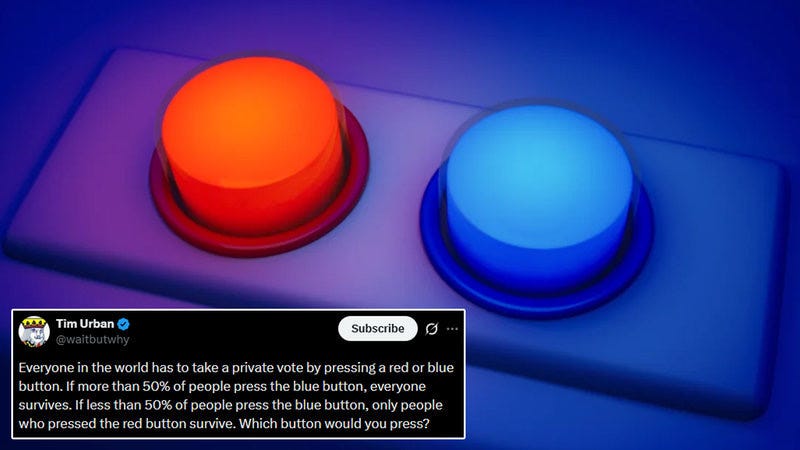
Take a moment to consider it and you will come to the conclusion that, in an ideal world, the majority presses blue and nobody dies. The blue button represents what game theorists call the Pareto Optimal outcome. This is defined as an outcome which is better for every person in every way. Which, if successful, blue is.
Seems simple, right? Press blue and trust that everyone else will too. Trust: that’s where things get difficult.
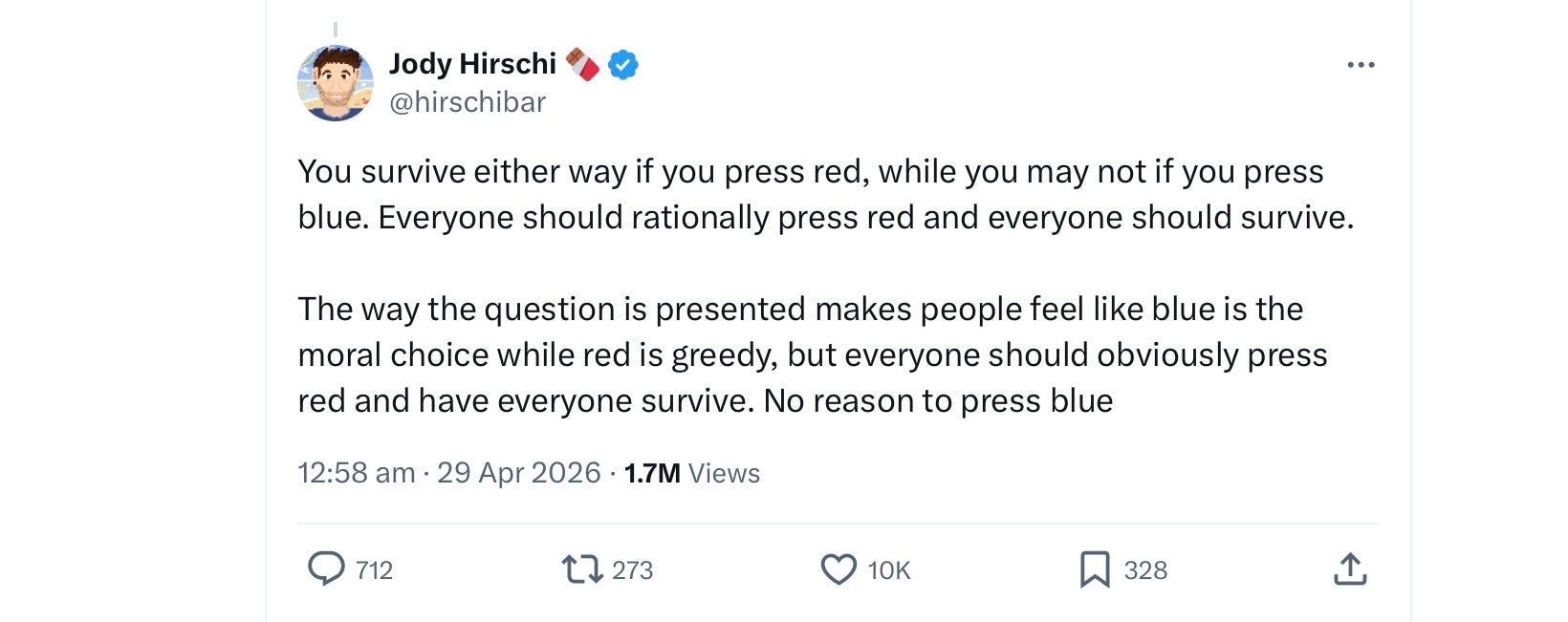
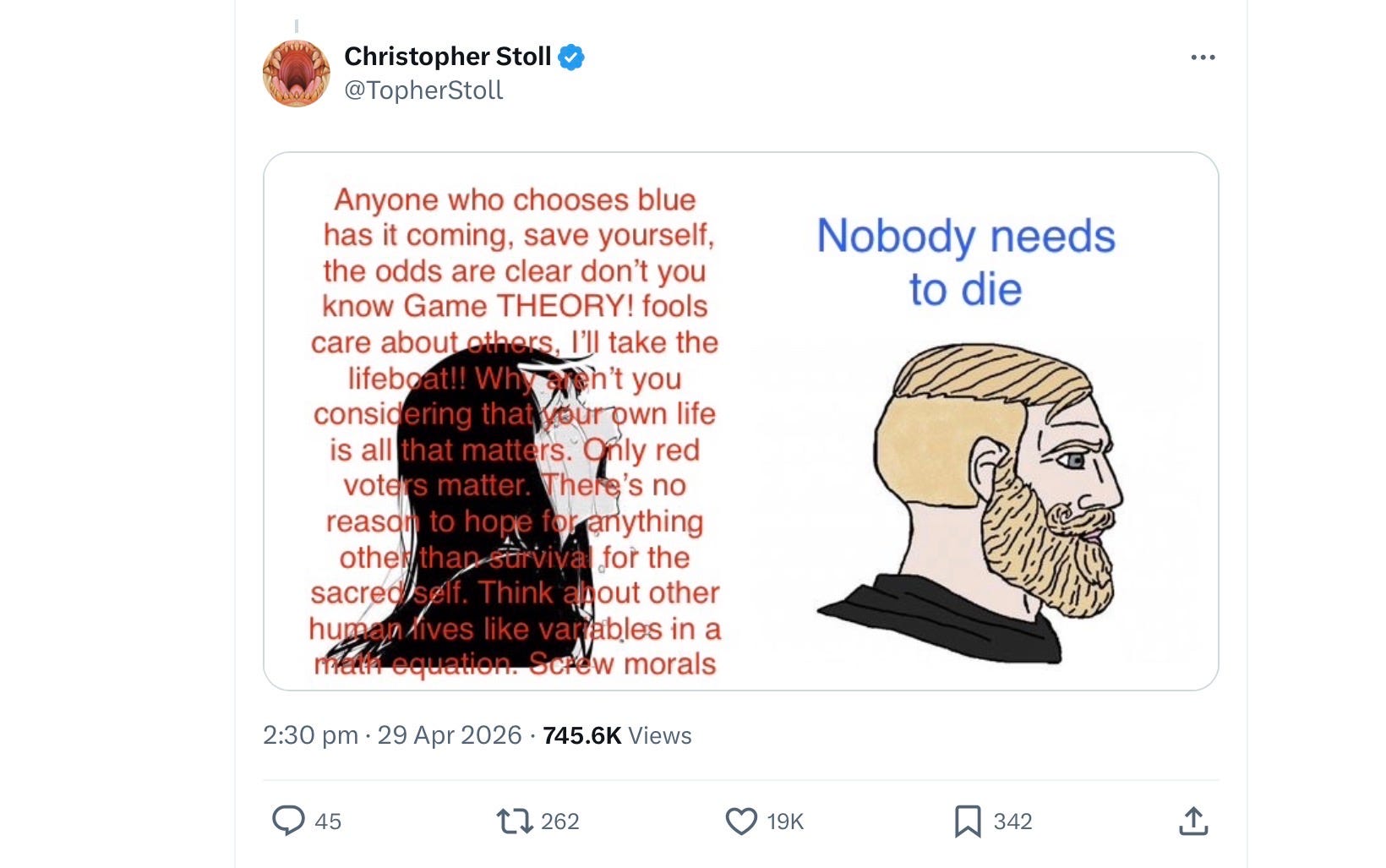
Ultimately, the thought experiment divides the world into pessimists and optimists: those who believe the majority are selfish, and those who trust the majority are selfless. Red button pressers believe that the majority of people value self-preservation above virtue. In their doubt, they fall into this category themselves.
This defensive choice demonstrates something called the Nash Equilibrium. This is a situation in which one does not benefit from changing their strategy, no matter how other decision-makers act. It is the safest way to guarantee the most profitable outcome for yourself. Essentially: save yourself regardless, let others take care of themselves. Red also has the potential to be an ideal outcome, if everybody presses it. You would only press the blue button to save yourself from a crisis you put yourself in. Why would you risk death when you could simply… not?
It’s inferred that:
- Nobody has any prior knowledge that this is going to happen
- Nobody can coordinate before the vote
- There is no way of knowing how others vote
Therefore, one cannot base the decision on the knowledge of what other people are doing, despite that being the exact focus of the decision itself. It would defeat the point of this ultimately being a societal trust experiment.
However, as this thankfully isn’t a real experiment, we have been able to observe the general response. Based largely on comments, twitter polls, and TikToks (as too many things seem to be nowadays), the consensus is relatively split, with the majority leaning towards blue. Note that this is likely influenced by factors that wouldn’t realistically be taken into account in the situation: prior discussion and knowledge that others would pick blue, a desire to be well-received on social media, the comfort of the choice being entirely hypothetical.
There are a thousand different ways to frame the question, each with slightly different biases:
Red: you could be partially responsible for half of the population’s death / Blue: you could die
Red: potentially kill people / Blue: If everyone presses this, everyone lives
Red: nothing happens / Blue: you enter the ultimate death gamble! you and everyone who presses this button dies unless half the population also engages in the ultimate death gamble!
There is a trolley coming towards you and others. You all have the choice to either pull the lever to divert the train or step off the tracks. The lever only works if at least half of you pull it.
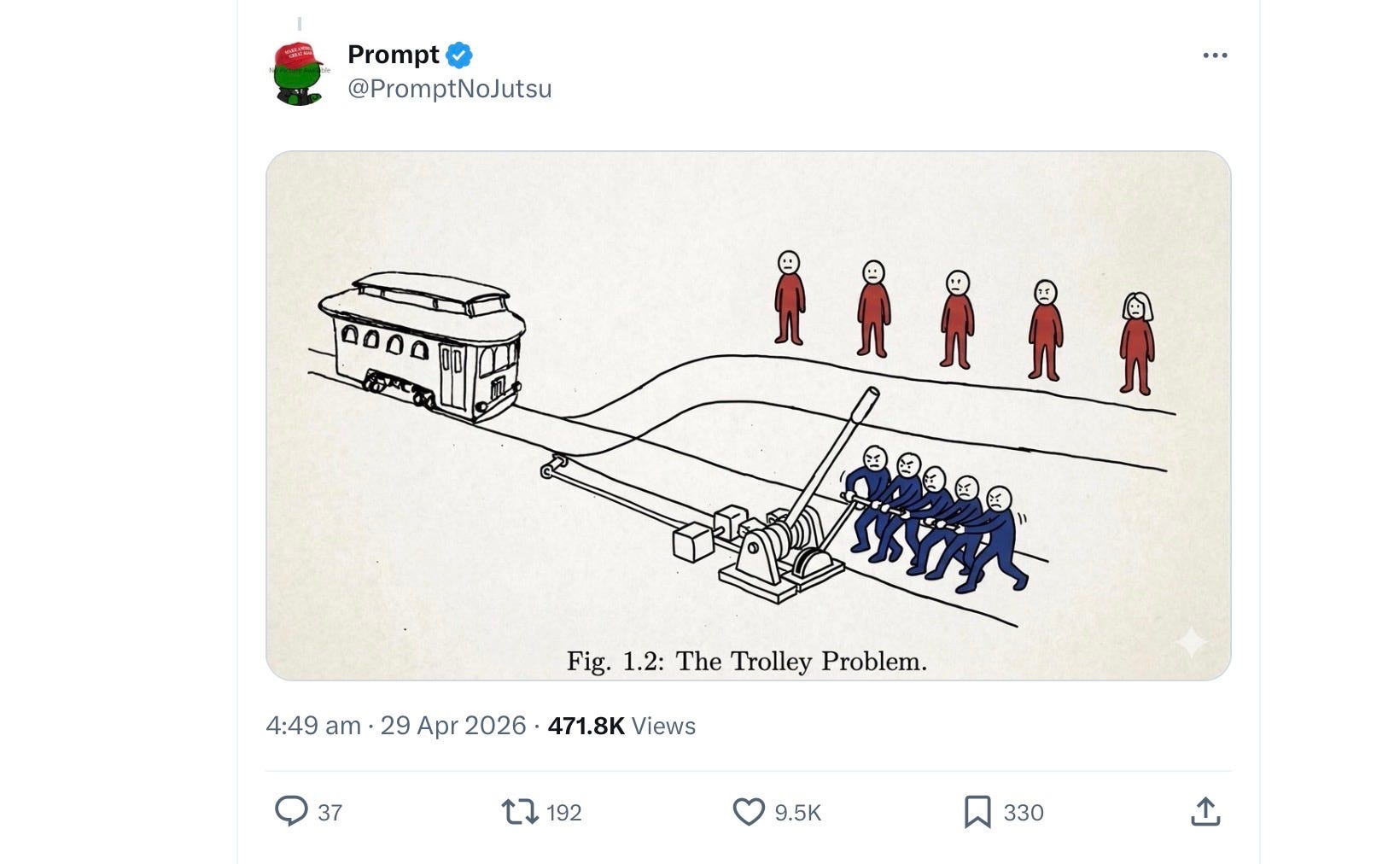
Regrettably, if the decision was genuinely sprung upon me with no prior communication, I would feel slightly more inclined to pick red, contradicting everything I believe in. As humans we have an innate instinct of self-preservation above all else. I don’t believe this is an instinct that most would be able to ignore if it truly came down to it (rather than the choice being an inconsequential twitter poll). Despite wanting wholeheartedly to live in a society of blue button pressers, I don’t think the majority would want to take the risk. Without knowing for certain which way people would choose to commit, I would prioritise my own safety. Does that make me selfish, sensible, or cowardly? Perhaps all of the above. Either way, I’d be alive!
TLDR: I know what I want the outcome to be, yet would actively choose to prevent it out of self-serving cowardice. Humans are weird. We all know the right answer, we just don’t trust each other enough to choose it.
But hey… with the red button, we don’t have to.